Our team is passionate about water. So we tested real water samples from actual Dallas-area homes — and the results were shocking. We’re not talking about muddy water or a weird smell. We’re talking about invisible, tasteless contaminants that build up in your body and can silently impact your long-term health.
In this article, we’ll walk you through what we found, explain what those numbers actually mean, and show you how to take control of your home’s water quality — once and for all.
We’re Dallas Water Doctor — a passionate, local team of filtration experts who care about doing things the right way. We’re not a franchise, and we’re not here to sell you something you don’t need. We’re here to give you the clarity, tools, and long-term solutions to protect you and your family — and your peace of mind.
What they are: PFAS (Per- and Polyfluoroalkyl Substances) are synthetic chemicals used in nonstick cookware, waterproof clothing, food wrappers, and even firefighting foam. They're called "forever chemicals" because your body can’t flush them out — and neither can the environment. They build up over time, silently accumulating in your blood, liver, and even breast milk.
Why it matters: Decades of research link PFAS exposure to cancer, hormone disruption, immune system suppression, and developmental delays in children. The EPA now recommends health advisory levels in the parts per quadrillion range — that's like a single drop in a swimming pool.
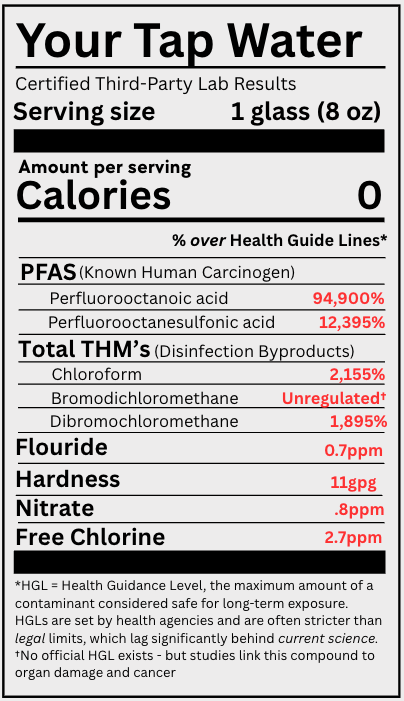
What we found in Dallas tap water:
Let’s put that in perspective: Imagine your doctor told you to limit your sun exposure to just 1 minute a day to prevent skin damage — but you stayed out for 10 hours. That’s the kind of gap we’re talking about. These levels aren't just over the line. They're deep into territory that health agencies now say may not be safe at all.
What they are: Trihalomethanes (THMs) like chloroform, bromodichloromethane, and dibromochloromethane form when chlorine — which cities use to kill bacteria — reacts with organic matter in the water (like decaying leaves, algae, or even runoff from farms).
Why it matters: While chlorine itself is necessary to prevent disease, THMs are not. Long-term exposure to these byproducts has been linked to increased risks of bladder cancer, liver and kidney damage, nervous system effects, and reproductive issues.
What we found in Dallas tap water:
There’s no official limit for Bromodichloromethane, but the science is clear: repeated exposure is associated with organ toxicity and cancer. Just because it's unregulated doesn't mean it's harmless. Imagine if a restaurant told you, "There’s no law against serving this ingredient... but it might cause cancer." Would you still eat there? Us neither.
We also found
Yes — city water is disinfected to protect you from bacteria and pathogens. But the treatment process itself introduces other risks. When chlorine reacts with organic material in the water supply, it creates toxic byproducts like chloroform.
And while the water may be "legal," many of the EPA's current limits were set decades ago — before we knew what we know now about how even tiny exposures can affect human health.
Let’s be real: "Legal" is not the same as "safe."
Basic filters — like the kind you get in a pitcher or fridge dispenser — can help with taste and odor. But they do almost nothing to remove PFAS, THMs, or nitrates. These chemicals are too small, too persistent, and too deeply embedded in the water.
A proper filtration system, especially a whole-home system, targets these contaminants at the point they enter your home. That means protection at every faucet, shower head, and ice cube tray — not just your drinking glass.
We offer free home visits to walk you through your specific water profile. We’ll show you what we found, explain what it means in plain language, and lay out real solutions — including the same technology we’ve installed in our own homes.
No pressure. Just the facts, your options, and a better path forward.
Take the Next Step - call us or book your free home water consultation today. Let us help you understand your water and take back control of what comes into your home.